A 19-year gap in healthy life expectancy currently divides the poorest and richest communities in the UK. This gap is not an accident. It is an active health emergency driven by severe pressures on living standards.
Our latest national research* shows that 2.6 million households (9%) said that their monthly household income was less than the cost of their essentials each month. This is an increase of 1.6 million households since we last asked the question in 2022. Our work on the National Red Index shows that, even if essential spending was minimised in line with debt advice, 1.7 million households would still be in the red.
When household budgets are forced into the red, health pays the price. Of those unable to cover their essentials, 67% report a direct negative impact on their mental health, and 47% report a decline in their physical health.
Turning the tide on health inequalities
Our ‘Turn the Tide’ campaign shows how the continuing pressure on living standards is no longer a short-term crisis, but a monthly reality for millions of people. We are calling for action on rent, energy and debt to help take the pressure of households across the country. It highlights the growing problem of negative budgets, when household incomes can’t cover their basic essential costs.
When essential costs outpace income, households are forced to go without the foundational building blocks of good health. In the 6 months leading to March 2026, 2.5 million households went without heating, hot water, or electricity, while 6 million were forced to cut back on food.
Going without is not simply a matter of tightening belts; it forces trade-offs that directly compromise physical and psychological wellbeing:
- Energy & Heating: Of those cutting back on energy, 54% lived in a colder home and 23% stopped or reduced cooking hot meals. Inadequately heated homes dramatically increase the risk of damp, mould, and severe respiratory illness
- Nutrition & Food Security: Of those cutting back on food, 30% skipped meals entirely, 58% bought less food, and 25% were forced to swap to cheaper, less healthy options
- Crisis Interventions: Almost 1.5 million households were forced to rely on food banks to access essentials
Our recent report on housing also highlighted the impact that high private rents and the inadequate level of support are having on low income renters. When controlling for income, people on Universal Credit in the private rental sector who don’t claim disability benefits and live in unaffordable housing spend 12% less on groceries and 10% less on utilities than those in affordable housing. For the group who claim disability benefits, unaffordable housing means that, on average, they spend 24% less on health-related costs, such as spending on care, mobility support or symptom management.
When people can’t afford to heat their homes or eat nutritious food, health inequalities do not just persist, they accelerate. To prevent further strain on individuals and the NHS, government policy must treat energy, housing, and debt relief as frontline health interventions.
Debt is taking a toll on people’s health
The ongoing pressure on living standards is driving millions into debt. Problem debt is not just a financial issue; it is a direct driver of poor health. It drains household income away from essentials and subjects individuals to relentless, inescapable stress. By reducing capacity to work and earn money, this can then be a barrier to escaping from debt.
Our survey reveals a stark divide in health and living standards between those in debt and those who are not. The chart below shows the proportion of people who according to our survey have experienced different issues related to worse health outcomes:
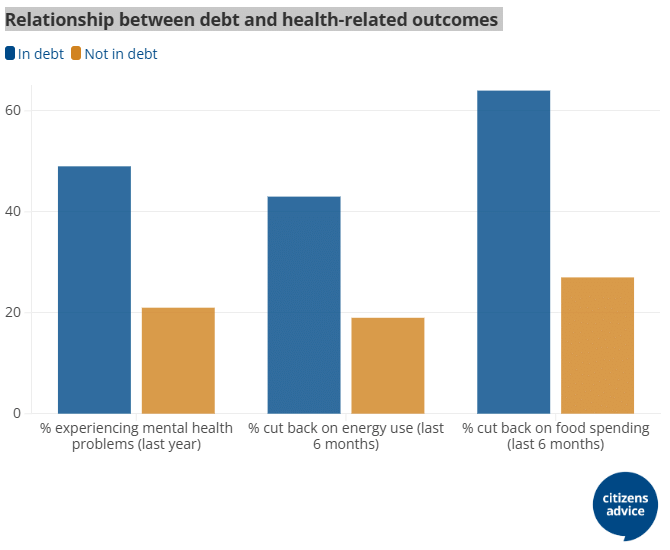
For households trapped in negative budgets, where essential costs outstrip income, debt acts like quicksand. Unmanageable repayments push families deeper into deficit, locking them into a vicious cycle that actively damages physical and psychological wellbeing.
Locking in inequality
While rising living costs affect everyone, the damage is felt most acutely at the bottom of the income distribution, particularly among disabled people and families with children.
Existing health conditions and disabilities magnify economic pressure. Disabled households often face non-negotiable costs, such as higher heating needs or running medical equipment, alongside structural barriers to employment.
- Disabled people are significantly more likely to be behind on essential bills, and were twice as likely to say they weren’t confident they would be able to afford food or energy over the next 3 months
- Frontline Citizens Advice data shows that disabled people and those with long-term health conditions are overrepresented among clients requiring food banks and crisis support
Children are similarly exposed. 34% of households with children are unable to cover all their essentials at least some of the time, compared to 25% of households without children. Failing to address these living standards today risks casting a long shadow over the next generation, entrenching severe health inequalities for decades to come.
Tina* lives with her children and their household income doesn’t cover their outgoings. This means that they consistently struggle to top up their pre-payment meter. She came to us because her energy supply had been shut off, and she needed a fuel voucher to ensure that her home would be warm enough for her children. But without a long term solution, she would continue to struggle to meet her energy costs, without seriously cutting back on things like food or rent payments.
Rebuilding the economic foundations of health
Tackling health inequality requires more than treating clinical symptoms; it demands fixing the economic foundations of everyday life. When households can’t afford heating, nutritious food, or basic stability, their health inevitably suffers.
To turn the tide on widening health gaps, government action must prioritise long-term relief for energy costs, housing insecurity, and problem debt. Ensuring everyone can afford the basic building blocks of life will be crucial for creating a healthier nation.
* Unless otherwise stated, all statistics are taken from a nationally representative Cost of Living survey, conducted by Walnut on behalf of Citizens Advice, in March 2026